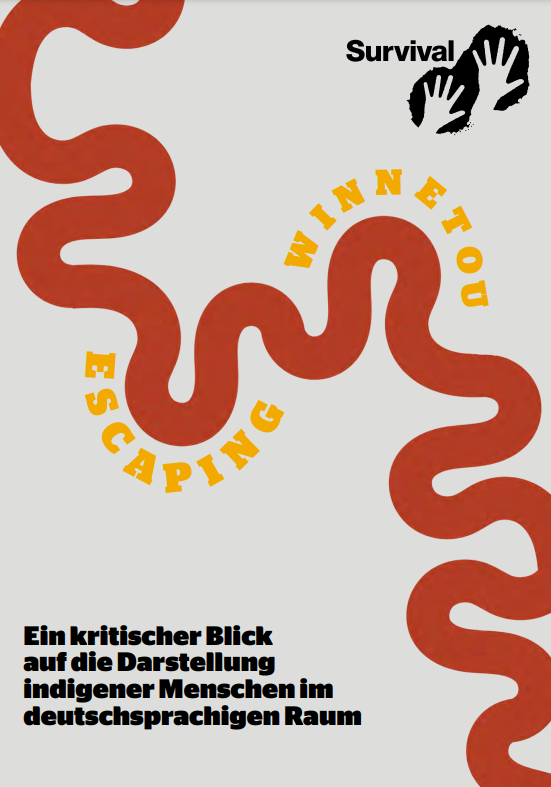
A play on our documentary’s name – “Escaping Winnetou” – the new Campaign at Survival International

Escaping Winnetou campaign at Survival International, the broschure is downloadable at the link.
Text German version below. Video at Vimeo.

We were contacted to give some commentary on the topic, which has returned to the stage as a new film of racist troupes and stereotypes was recently released. The willful insistence of Germans of this type to not only perpetuate harmful stereotypes but to introduce and reinforce their use in a new generation is on full display, even as normalized racism and white supremacist ideology is on the rise.

The simple fact of the matter is: You cannot make “better” racist films by “updating” material and still using the same troupes, characters, names and Eurocentric, whitecentric structures and producers. This is impossible. Racism is racism. Organizations, museums or anything else that have used Natives for profit, interest and personal gain aren’t suddenly better because they share some stats or information about Natives today. That absolves you of Nothing and is purely self-delusion.

As in the previous post, about our 14 August interview at Deutschlandradio Kultur, we shared there continues to be individuals and groups working positively with Natives. In healthy, non-racist, non-Eurocentric collaborations and cooperation with Indigenous peoples. They Never make the spotlight because that would show it is possible Not to be racist and still enjoy Native peoples and cultures. That shows how wrong the way such filmmakers and producers, hobbyists, and “Indian” shows actually are, that it is self-gratifying even arrogant behaviors, and facets of rape culture: “We will use you for our pleasure whether you like it or not, and even if you say ‘please don’t do this’, we will do it anyway!” A terrible mindset.

Survival International has created a brochure gathering information and data on persistent cultural appropriation and racist practices in Germany, particularly with Native and Indigenous peoples. It is the explanation and introduction for their current campaign, Escaping Winnetou, which will presumably last the next months.

We were asked if we might like to be part of it, but we’ll see in the future what that looks like, as they had not offered or defined a specific way for us to do so. That’s always a frustrating aspect, because effectively, it’s a structural way non-Natives are still narrating and presenting Indigenous peoples.

Visit the site, watch the video, but more importantly, think about how you can help change our societies for the better each day. Sometimes that’s not easy, even in small ways, but it’s possible and necessary that every single one of us try to do so.


The “Cycle of Genocide” image was created by Ižaŋžaŋwiŋ.


Wir wurden um einen Kommentar zu diesem Thema gebeten, das durch die Veröffentlichung eines neuen Films mit rassistischen Klischees und Stereotypen wieder in den Fokus gerückt ist. Das beharrliche Festhalten dieser Art von Deutschen daran, schädliche Stereotypen nicht nur aufrechtzuerhalten, sondern sie auch einer neuen Generation zu vermitteln und zu verfestigen, ist offensichtlich, auch wenn normalisierter Rassismus und die Ideologie der weißen Vorherrschaft auf dem Vormarsch sind.

Die einfache Tatsache ist: Man kann keine „besseren” rassistischen Filme machen, indem man das Material „aktualisiert” und dabei weiterhin dieselben Klischees, Charaktere, Namen und eurozentrischen, weißzentrierten Strukturen und Produzenten verwendet. Das ist unmöglich. Rassismus ist Rassismus. Organisationen, Museen oder andere Einrichtungen, die Native für Profit, Interessen und persönlichen Gewinn ausgenutzt haben, werden nicht plötzlich besser, nur weil sie heute einige Statistiken oder Informationen über Native veröffentlichen. Das entlastet Sie in keiner Weise und ist reine Selbsttäuschung.

Wie im vorherigen Beitrag über unser Interview vom 14. August bei Deutschlandradio Kultur haben wir berichtet, dass es weiterhin Einzelpersonen und Gruppen gibt, die positiv mit den Natives zusammenarbeiten. In einer gesunden, nicht rassistischen, nicht eurozentrischen Zusammenarbeit und Kooperation mit indigenen Völkern. Sie stehen nie im Rampenlicht, weil das zeigen würde, dass es möglich ist, nicht rassistisch zu sein und dennoch die Natives und ihre Kulturen zu genießen. Das zeigt, wie falsch die Vorgehensweise solcher Filmemacher und Produzenten, Hobbyisten und „Indianer”-Shows tatsächlich ist, dass es sich um selbstgefälliges, sogar arrogantes Verhalten und Facetten einer Vergewaltigungskultur handelt: „Wir werden euch zu unserem Vergnügen benutzen, ob ihr es wollt oder nicht, und selbst wenn ihr sagt ‚Bitte tut das nicht’, werden wir es trotzdem tun!” Eine schreckliche Denkweise.

Survival International hat eine Broschüre mit Informationen und Daten über anhaltende kulturelle Aneignung und rassistische Praktiken in Deutschland, insbesondere gegenüber Native und indigenen Völkern, erstellt. Sie dient als Erklärung und Einführung für ihre aktuelle Kampagne „Escaping Winnetou”, die voraussichtlich die nächsten Monate dauern wird.

Wir wurden gefragt, ob wir daran teilnehmen möchten, aber wir werden in Zukunft sehen, wie das aussehen wird, da sie uns keine konkrete Möglichkeit dafür angeboten oder definiert haben. Das ist immer ein frustrierender Aspekt, denn effektiv ist es eine strukturelle Art und Weise, wie Nicht-Native immer noch über indigene Völker berichten und sie darstellen.

Besuchen Sie die Website, schauen Sie sich das Video an, aber denken Sie vor allem darüber nach, wie Sie dazu beitragen können, unsere Gesellschaften jeden Tag ein bisschen besser zu machen. Das ist manchmal nicht einfach, selbst in kleinen Schritten, aber es ist möglich und notwendig, dass jeder einzelne von uns sich darum bemüht.


Film Citation: CINEPHILE, Vol. 16, no.1, University of British Columbia’s film journal, “The Transnational White Indian”

cinephile
Our documentary was cited and discussed in #CINEPHILE, Vol. 16, no.1, University of British Columbia’s film journal, “The Transnational White Indian”. The PDF is available online for download here.

In the excellent preface by Robert Stam, it helps explain why it’s so many mid to older German ytguys especially continue to idolize & defend appropriation and misrepresentation practices. The homo-erotic, homo-social aspects of Shatterhand & Winnetou’s relationship is distinct in Karl May’s novels, and the whitewashing or eurocentrizing of Natives.

But there’s great info throughout Stam’s chapter on the romanticization of genocide, the usurping/replacement of actual Natives by yts, and the coveting or “ownership” of Indigenous cultures by self-named experts 🙄. Stam traces the history of Native stereotypes from the beginning of motion pictures and relevant literature in the 19th and 20th centuries, and briefly why #Germany is the most notorious.

What are some of the main issues of such practices and behaviors?

1. It harms and erases the cultures targeted, plus who were/are the ones who that enacted and still benefit from genocidal practices.

2. Distracts from recognizing & healing the internal antagonism, stereotyping and trauma in European societies seeking escapism through appropriation.

3. As an example, research is finding the white male demographic is the largest sudden move in claiming nonbinary & other identities PLUS are the ONLY group closest to Native Americans in suicide rates after a certain age.

This is no surprise. On one end of this spectrum you have the culturally appropriated and misrepresented, and on the other end, those who have brutalized and culturally destroyed themselves and others. They hold and withhold and monopolize structural power gained through horrific acts of violence through the centuries, against their own peoples as well, yet now many claim we who oppose them are trying to deny their rights to nostalgic racism, sexism, ableism, misogyny and homo- & transphobia. Basically, they wish to continue exploiting, misusing and abusing others, and dislike and resent anyone who calls them out and demands they Stop.

Don’t be taken in by such rhetoric, such “woe is me”, “reverse racism” and/or “but real women are” rationalizations for discrimination, stereotyping and hate.


If you’re interested in screening our documentary, please visit our Contact & FAQs page.

Description: “The same mentality that ignores Indigenous rights to self-representation are often those who also stereotype and gaslight GLBTIIQ people, women (of all types), the disabled or economically challenged, especially people of color just for desiring change and equality. It is basically saying, “My gratification is more important than your dignity, your rights or even your life.” This is a main facet of rape culture. It is intersecting oppression. Trailer.

A list of most other Red Haircrow citations on these specific topics can be found at Google Scholar. The citations include Red’s work, interviews, commentary and other multimedia.

Racism as Culture: Carnival Costumes, #CulturalAppropriation & #Germany – #Faschingskostüme #KulturelleAneignung

mdr2

VIDEO – This week on (link) MDR’s “recap” – Faschingskostüme: Ist Rassismus vielen egal? Myself and several others on the topic of racism, cultural appropriation, carnival, rassimus, Faschingskostüme, Kulturelle Aneignung.

We ask: How do you educate upon these topics in meaningful ways and create change to end racist practices? Like the title of our documentary clearly suggests, there is a wrong and a better way to show appreciation, indicate interest or learn about other peoples and cultures that do not perpetuate cycles of erasure, violence, and misogyny (+transphobia). Learn more here: flyingwithredhaircrow.com.

Description: “Finally #Carnival again! That means celebrating exuberantly, swaying, dressing up. But apparently, this year, too, that doesn’t go without missteps. At a carnival reception in Hesse, there is a “blackfacing” scandal. In Prossen, Saxony, people in “Indian” #costumes drive through town during a carnival parade, and a man in a rainbow suit is tied to a torture stake. And we ask ourselves: why are certain costumes problematic?

For this, we take a look at history, more precisely at the time of colonialism. At that time, many ethnic groups were oppressed and considered inferior. Their clothing and culture were looked down upon. Today, for example, dressing up as #NativeAmerican without dealing with their history is unacceptable, Red Haircrow tells us in the video.

And yet, “Ind*aner” costumes are still everywhere. Many fools don’t understand the fuss over the disguise. Do many not care about #racism? We asked academics and those affected for their take.”

Note: By the way, I was addressed by MDR in English and never asked if I speak German. Which of course I do, I was born in Germany and have spent the last almost twenty years back in Germany. Another example that one can recognize the problems of stereotyping, but still make false assumptions about other things that interfere with intercultural well-being.


Wir fragen: Wie kann man auf sinnvolle Weise über diese Themen aufklären und Veränderungen bewirken, um rassistische Praktiken zu beenden? Wie der Titel unseres Dokumentarfilms deutlich macht, gibt es einen falschen und einen besseren Weg, Wertschätzung zu zeigen, Interesse zu bekunden oder etwas über andere Menschen und Kulturen zu lernen, ohne den Kreislauf von Auslöschung, Gewalt und Frauen- oder transfeindlichkeit aufrechtzuerhalten. Erfahren Sie hier mehr: flyingwithredhaircrow.com.


Beschreibung: “Endlich wieder Karneval! Das heißt ausgelassen feiern, schunkeln, verkleiden. Aber offenbar geht das auch in diesem Jahr nicht ohne Fehltritte. Bei einem Fastnachtsempfang in Hessen gibt es einen “Blackfacing”-Skandal. Im sächsischen Prossen fahren Menschen im “Indianer”-Kostüm bei einem Karnevalsumzug durch den Ort, ein Mann in Regenbogen-Anzug ist an einen Marterpfahl gefesselt.Und wir fragen uns: Warum sind bestimmte Kostüme problematisch?

Wir werfen dafür einen Blick in die Geschichte, genauer gesagt in die Zeit des Kolonialismus. Damals wurden viele Volksgruppen unterdrückt und als minderwertig betrachtet. Auf ihre Kleidung und Kultur wurde herabgeschaut. Sich heutzutage zum Beispiel als Native American zu verkleiden, ohne sich mit ihrer Geschichte zu beschäftigen, sei inakzeptabel, erklärt uns Red Haircrow im Video.

Und doch sind “Ind*aner”-Kostüme nach wie vor überall zu sehen. Viele Narren verstehen die Aufregung um die Verkleidung nicht. Ist Rassismus vielen egal? Wir haben Wissenschaftler und Betroffene nach ihrer Einschätzung gefragt.”


Kapitel:
00:00 Intro
00:45 Wo gibt es Rassismus im Karneval?
02:35 Krasse Kostüme in Onlineshops
03:27 Was macht die Kostüme problematisch?
04:36 Kulturelle Aneignung im Karneval
06:42 Warum werden rassistische Kostüme trotzdem getragen
07:18 Hat Karneval ein Rassismusproblem?
08:00 Kostümverbot für Kinder?
09:50 Sarahs Meinung
10:34 Endcard

HINWEIS: Übrigens wurde ich vom MDR auf Englisch angesprochen und nie gefragt, ob ich Deutsch spreche. Was ich natürlich tue, ich bin in Deutschland geboren und habe die letzten fast zwanzig Jahre wieder in Deutschland verbracht. Ein weiteres Beispiel, man kann die Probleme der Stereotypisierung erkennen, aber trotzdem falsche Annahmen über andere Dinge machen, die das Wohlbefinden stören.

Rechtzeitig zu #Fasching & #Karneval: “Dumme Klischees haben Auswirkungen auf das Leben echter Menschen” – #NativeAmerican #Stereotypes #Germany


rsd

“Absoluter Geheimtipp auf Disney+ bekommt eine dritte Staffel!” by Kristina Kielblock at kino.de. (In German)

(In German below). A new article on some of the current and upcoming shows centering Native American, First Nations and Indigenous peoples that (most importantly) were made by Natives for everyone. Natives also working in healthy cooperation and collaborations with other peoples and groups to produce work both, fiction and non-fiction, that include or focus on Native characters stories….without the Eurocentrism, misrepresentation and stereotyping.

Understand what that means because inevitably (and we see it constantly) there are comments from non-Natives who say, “But they sometimes do stereotypes! Why is it so different or bad if we do it?” or even more exasperating, “We love Natives, and just want to create characters and stories, too! Where’s the harm in that?” Besides our documentary, there are MANY resources that explain how, why and when racism and Eurocentrism continues to work in our societies, what it’s symptoms and effects are. There are MANY resources that explain and clearly demonstrate the harm that results, and the cycles of erasure, silencing and replacing Native peoples, voices and self-determination that continue the purposes of colonialism and Indigenous genocide. 

The only time Germany and the western world seems to really consider these topics as a nation or societies is during a controversy, such as climaxed in August 2022 following the release of children’s books no less, that sought to revive and defend the use of racist, sexist terms used for Natives that are strongly condemned, which they were made well aware of long before going to press. What is especially frustrating about such behavior and societal practices, is that like Indian hobbyists of all kinds, they overshadow or completely obscure the many Europeans who have long been allies, colleagues and partners to Indigenous peoples, working to undo centuries of Eurocentrism and colonialism through healthy relationships and cooperation of all kinds with Native peoples. We get dozens of articles about hobbyists, books and reports by so-called “Indian experts” and ad nauseum novels, shows and films romanticizing Native stereotypes or misrepresenting/skewing current events, but few or NONE about good collaborations. 

Stereotypes are oversimplifications of other peoples, groups and individuals of which one is not a part, often based on historical fears and ignorance. In the case of Europeans doing this to ethnic and racial groups, this has an overwhelmingly negative effect because of the violently gained and held structural power to control all narratives, which the targeted groups have little or no opportunity to correct or change, all while being subjected to discrimination, compartmentalization and dehumanization. In the case of Native American peoples, cultures and traditions, in Germany especially, decades of moneymaking exploitation of all kinds, from museums, to media studios, to tobacco products.

Simply put: When we as Native peoples talk about ourselves, our communities, our histories, our cultures, our traditions, our idiosyncrasies, we are not stereotyping because it is coming from a place of intimate, personal knowledge about ourselves, our communities, our histories, our cultures, our traditions, our idiosyncrasies. That is not hard to understand although it takes humility, often absent in western society, and realize, too, in that sentence you can substitute any other marginalized or minoritized groups for “Native peoples”. Look around you in western society, just like our documentary’s premise, the same attitude and treatment of Natives is done to others, and even to the environment, our Earth, our home. Destruction, pain and harm are ignored, minimized or defended for self-gratification and/or profit. 

That’s why we continue say, no shout and yell, that it is well past time to symbolically #ForgetWinnetou! and the harmful practices, behaviors and mentalities that continue colonial, genocidal systems that encourage the stereotyping, erasure and silencing of certain “others”. 


Ein neuer Artikel über einige der aktuellen und kommenden Serien, die sich mit Native Americans, First Nations und indigenen Gruppen befassen und (vor allem) von Natives für alle gemacht wurden. Eingeborene arbeiten auch in gesunder Kooperation und Zusammenarbeit mit anderen Völkern und Gruppen, um Werke zu produzieren, sowohl Belletristik als auch Sachbücher, die Geschichten von indigenen Charakteren enthalten oder sich auf diese konzentrieren…., ohne den Eurozentrismus, die falsche Darstellung und Stereotypisierung.

Verstehen Sie, was das bedeutet, denn unweigerlich (und wir sehen es ständig) gibt es Kommentare von Nicht-Natives, die sagen: “Aber sie machen manchmal Stereotypen! Warum ist es so anders oder schlecht, wenn wir es auch tun?” oder noch ärgerlicher: “Wir lieben die Eingeborenen und wollen auch Figuren und Geschichten erschaffen! Was ist daran so schlimm?” Neben unserem Dokumentarfilm gibt es VIELE Quellen, die erklären, wie, warum und wann Rassismus und Eurozentrismus in unserer Gesellschaft weiter wirken, was seine Symptome und Auswirkungen sind. Es gibt VIELE Quellen, die den Schaden, der daraus resultiert, und die Zyklen der Auslöschung, des Schweigens und der Verdrängung von indigenen Völkern, Stimmen und Selbstbestimmung, die die Ziele des Kolonialismus und des indigenen Völkermordes fortsetzen, erklären und klar aufzeigen.

Das einzige Mal, dass sich Deutschland und die westliche Welt als Nation oder Gesellschaft wirklich mit diesen Themen auseinandersetzen, ist während einer Kontroverse, wie sie im August 2022 nach der Veröffentlichung von Kinderbüchern ihren Höhepunkt erreichte, in der versucht wurde, die Verwendung rassistischer und sexistischer Bezeichnungen für indigene Gruppen wiederzubeleben und zu verteidigen, die aufs Schärfste verurteilt werden und über die sie lange vor der Veröffentlichung informiert wurden. Besonders frustrierend an solchen Verhaltensweisen und gesellschaftlichen Praktiken ist, dass sie – wie indianische Bastler aller Art – die vielen Europäer in den Schatten stellen oder völlig ausblenden, die seit langem Verbündete, Kollegen und Partner der indigenen Völker sind und daran arbeiten, Jahrhunderte des Eurozentrismus und Kolonialismus durch gesunde Beziehungen und Kooperationen aller Art mit den indigenen Volksgruppen zu überwinden. Es gibt Dutzende von Artikeln über Hobbyisten, Bücher und Berichte von so genannten “Indianerexperten” und bis zum Überdruss Romane, Serien und Filme, in denen indigene Stereotypen romantisiert oder aktuelle Ereignisse falsch dargestellt oder verdreht werden, aber nur wenige oder KEINE über gute Zusammenarbeit.

Stereotypen sind vereinfachte Darstellungen anderer Völker, Gruppen und Individuen, denen man nicht angehört, und beruhen oft auf historischen Ängsten und Unwissenheit. Im Falle der Europäer, die dies bei ethnischen und rassischen Gruppen tun, hat dies eine überwältigend negative Wirkung, da sie gewaltsam die strukturelle Macht erlangen und behalten, alle Narrative zu kontrollieren, die die Zielgruppen kaum oder gar nicht korrigieren oder ändern können, während sie gleichzeitig Diskriminierung, Abschottung und Entmenschlichung ausgesetzt sind. Im Fall der indianischen Völker, Kulturen und Traditionen, insbesondere in Deutschland, ist dies eine jahrzehntelange Ausbeutung zu Geldzwecken aller Art, von Museen über Medienstudios bis hin zu Tabakprodukten.

Einfach ausgedrückt: Wenn wir als Native Nations über uns selbst, unsere Gemeinschaften, unsere Geschichte, unsere Kulturen, unsere Traditionen, unsere Eigenheiten sprechen, dann tun wir das nicht stereotyp, denn es kommt von einem Ort intimer, persönlicher Kenntnis über uns selbst, unsere Gemeinschaften, unsere Geschichte, unsere Kulturen, unsere Traditionen, unsere Eigenheiten. Das ist nicht schwer zu verstehen, auch wenn man dazu Demut braucht, die in der westlichen Gesellschaft oft nicht vorhanden ist, und man sollte sich auch darüber im Klaren sein, dass man in diesem Satz ” Native Peoples” durch jede andere marginalisierte oder minorisierte Gruppe ersetzen kann. Schauen Sie sich in der westlichen Gesellschaft um, genau wie die Prämisse unseres Dokumentarfilms, die gleiche Einstellung und Behandlung der “Natives” wird anderen angetan, und sogar der Umwelt, unserer Erde, unserem Zuhause. Zerstörung, Schmerz und Schaden werden ignoriert, verharmlost oder aus Gründen der Selbstbefriedigung und/oder des Profits verteidigt.

Deshalb sagen wir weiterhin, nein, wir brüllen, dass es längst an der Zeit ist, symbolisch #ForgetWinnetou! und die schädlichen Praktiken, Verhaltensweisen und Mentalitäten zu vergessen, die koloniale, völkermörderische Systeme fortsetzen, die die Stereotypisierung, Auslöschung und das Verstummen bestimmter “Anderer” fördern.

Sharing an important statement from the Native American Association of Germany – “Soll Winnetou abgeschafft werden?” (In Deutsch)

naaog

Bitte lesen Sie die vollständige Erklärung auf ihrer Website, die ich mit dieser zusätzlichen Anerkennung voll unterstütze: In Deutschland bezieht sich der Begriff “Natives” zwar in erster Linie auf die Native Nordamerikaner, insbesondere auf die Plains Nations, aber auch auf alle indigenen Gruppen in “Amerikas”. Eine von den Europäern geschaffene und durchgesetzte Bezeichnung, die die Namen der Kontinente durch ihre tatsächlichen Originalbewohner, die Natives, die immer noch hier sind, ignoriert.

Please read the full statement on their website, which I fully endorse with this additional acknowledgement: In Germany, while the term “Native” refers primarily to Native North Americans, especially the Plains Nations, it also refers to all indigenous groups in “the Americas.” A term created and enforced by Europeans that ignores the names of the continents by their actual original inhabitants, the Natives, who are still here. The NAAoG statement will be translated to English in the next days.

The protests and demand for removal and banning of the term “squ*w began decades ago in North America, supported by many Native nations, peoples, non-Natives and objective researchers on the etymology of the term, its origin, historic and contemporary usage, which was deemed racist, sexist exploitive and reductive.

“The word itself is a constant reminder of the unjust treatment of the Native people, of the Washoe people,” said Darrel Cruz of the Washoe Tribe Historic Preservation Office. “It’s a constant reminder of those time periods when it was not good for us. It’s a term that was inflicted upon us by somebody else and we don’t agree with it.”

On state and local level, and now on national levels supported by Senator Debbie Haaland (Navajo/Diné), President Biden and many, many others who wish to the end of any sexualized derogatory terms for Native women, who continue to suffer sexual assault and rape higher than any other demographic group, with over 90% of the perpetrators being non-Native men.

RAVENSBURGER WAS FULLY MADE AWARE OF THIS AND OTHER OFFENSIVE PRACTICES AND TERMS FOR YEARS. THEY DELIBERATELY CHOSE TO CONTINUE PRODUCTION THIS YEAR AND ONLY AFTER PROTEST ISSUED A NON-APOLOGY, WHICH HAS GENERATED ANGRY BACKLASH DUE TO WIDESPREAD DELIBERATE MISINFORMATION CIRCULATED BY GERMAN MEDIA.


von Carmen Kwasny (Vorsitzende):

“Am 23.08.2022 fing morgens das Telefon an zu klingeln und hörte bis in die Abendstunden hinein nicht mehr auf. Parallel dazu landeten weitere Interviewanfragen in unserem E-Mail-Postfach. Was war geschehen?

Continue reading “Sharing an important statement from the Native American Association of Germany – “Soll Winnetou abgeschafft werden?” (In Deutsch)”

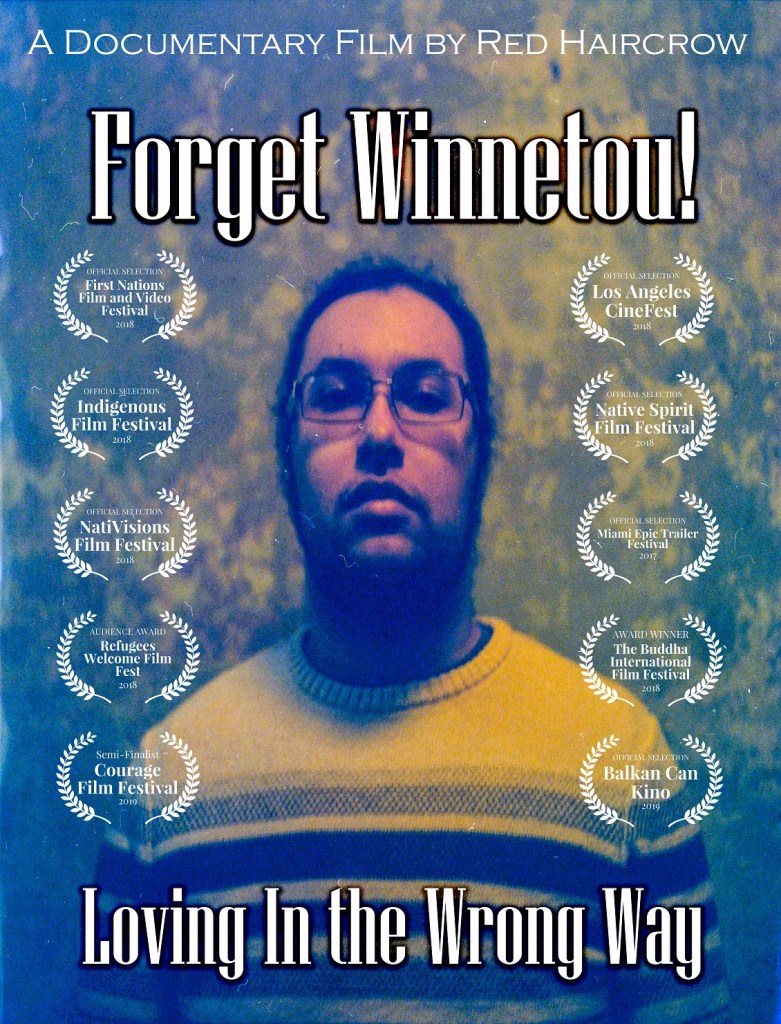
Now available on DVD – “Forget Winnetou! Loving in the Wrong Way”


Now available on DVD at eBay, the 2018 award winning documentary, “Forget Winnetou! Loving in the Wrong Way”, directed, produced and edited by Red Haircrow. Quantities are limited in this first test.

Format: DVD
Region: PAL
Genre: Dokumentarfilm/Documentary
Erscheinungsjahr/Released: 2018
Audio: German/Deutsch, English/Englisch
Untertiteln/Undertitles: Deutsch
Laufzeit/Runtime: 70min.

Description: “The same mentality that ignores indigenous rights to self-representation are often those who also stereotypes and gaslight GLBTIIQ people, women’s rights, the disabled or economically challenged, especially BIPOC just for desiring change and equality. It is basically saying, “My gratification is more important than your dignity, your rights or even your life.” This is a main facet of rape culture. It is intersecting oppression.

Most films about Natives concentrate on European narratives or indigenous experience in North America but there are Natives abroad and being “loved in the wrong way” in “Indian crazy” Germany has many forms and effects.

Germany is a microcosm of struggles taking place across western society both against and for decolonization; for correcting white privilege, supremacist belief and a patriarchal mentality that’s divided and helped destroy cultures, peoples and our world. We explore the roots of racism, colonialism, and appropriation in Germany from a rarely considered perspective: the Native American they adore.”

Der Überblick: “Dieselbe Haltung, die das Recht indigener Völker auf Selbstdarstellung ignoriert, ist es auch, die GLBTIIQ-Menschen, Frauen, Behinderte oder wirtschaftlich Benachteiligte, insbesondere People of Color, stereotypisiert und gaslighted, d.h. ihnen die Realität ihrer Erfahrungen abspricht, nur weil sie sich Veränderungen und Gleichberechtigung wünschen. Im Grunde heißt das: “Meine Freiheit und meine Bedürfnisse sind wichtiger als deine Würde, deine Rechte oder sogar dein Leben.” Es ist eine sich überschneidende Unterdrückung.

Die meisten Filme über Native Americans konzentrieren sich auf europäische Erzählungen oder indigene Erfahrungen in Nordamerika, aber es gibt auch Native Americans im Ausland, und im “indianerverrückten” Deutschland – “auf die falsche Art geliebt” zu werden, hat viele Formen. Deutschland ist ein Mikrokosmos der Kämpfe, die überall auf der Welt stattfinden, sowohl gegen als auch für die Dekolonialisierung; für die Überwindung der weißen Vorherrschaft und des Imperialismus, die unsere Welt gespalten und zerstört haben.

Wir erforschen die Wurzeln von Rassismus, Kolonialismus und Kultureller Aneignung in Deutschland aus einer selten beachteten Perspektive: dem Stereotyp der indigenen Amerikaner, die sie zu verehren vorgeben.”

21 Nov. #Documentary #Screening & Discussion in #Berlin with Xart Splitta & Guest – Karin Louise Hermes

  • Where –  Xart Splitta, Hasanheide 73, 10967 Berlin
  • Time – 7pm-10pm
  • Language– German & English (film & discussion)
  • Cost – Donations accepted
  • Facebook Event page

November is Native American Heritage Month, a national holiday in the USA. But there and here in Germany, the dehumanization and objectification of Indigenous peoples, and the minimization or erasure of historical acts and issues continues. Colonial behaviors and practices that are connected to the most serious, even life threatening problems humanity now faces.

Germany is well known for its cultural appropriation and ideation of American Indians. Misinformation, stereotypes and Eurocentric narratives are widespread. “Playing Indian” as a costume or a lifestyle has been normalized for generations, largely with the help or excuse of Karl May’s work.

Whether one agrees with such practices or not, most don’t recognize it for what it is: #Colonialism2019 and Systemic Racism. Why are Native and Indigenous issues too often left out of conversations on racism in Germany? Why do so many people, even anti-racism or social justice activists continue to tokenize/primitize Indigenous peoples and/or leave them out of conversations on how to survive and create a better world for all peoples?

What truly is intersectional activism and why is it critically important for Indigenous peoples, the history of their treatment and contemporary reality to take stage alongside any and every other action on anti-colonialism, anti-racism and climate crisis? What can you do? What should you do? How can we work together?

We’re going to talk about it on 21 November!


Meet our guest:

Karin Louise Hermes is a Filipina-German academic based in Berlin, Germany. Karin has participated in, organized and reported on many inter-sectional political issues at climate crisis conferences, during direct actions and demonstrations and other endeavors on Indigenous self-representation, ending racism and colonialism. She holds a MA in Pacific Island Studies from the University of Hawai’i, and is a PhD candidate in American Studies at Humboldt-Universität Berlin. One of her articles, “Why I protest“.
We’re a Finalist in the 2019 Overcome Film Festival! #Indigenous #Documentary #Films

Pleased to share our documentary has been selected as a finalist in the 2019 Overcome Film Festival. It’s especially amazing in that this is my first feature length documentary, as I’d described myself only as a slightly advanced beginner. It speaks to the intersectionality and importance of the topic, the strength and sincerity of the participants (see this here), and justifies the hard painful work so many of us put into the project, refusing to give up.

More about the festival, and head to their site to check out their partners and the many great causes they support:

“The 2019 Overcome Film Festival is the international event for all storytellers, filmmakers, and artists to tell the world their stories of survival and triumph over adversity. The 2019 official program will include Features and Short films in the categories of live-action, animation, narrative, non-narrative, experimental, and audiovisual poetry with 27 Award categories.

The Overcome Film Festival especially encourages and welcomes the entries of filmmakers all over the world who want to share their experiences in overcoming adversity or any other factor that has contributed to their growth as a person and motivated them to celebrate their existence. It is the focus of the film festival to give survivors a voice and a venue to share their life experiences and provide hope to others regardless of where they come from in the world.”

October 14th at The #Indigenous Film & Arts Festival in #Denver, Colorado

An opportunity for interested audiences to see our documentary stateside, in Denver, CO, as part of the annual Indigenous Film & Arts Festival 2019.
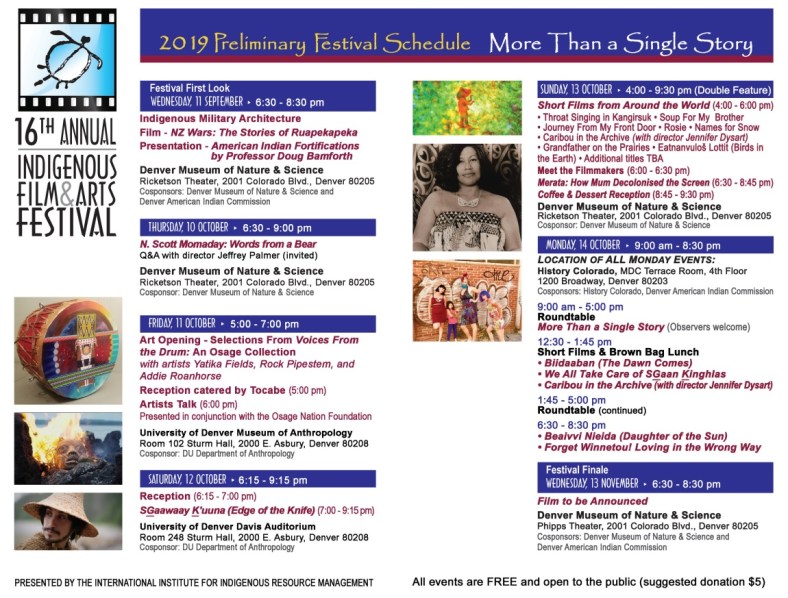
We’re pleased to finally make it public, we’ll be screening in Denver, Colorado on October 14th at the Indigenous Film & Art Festival! It’s organized by the International Institute for Indigenous Resource Management, and the host organization is History Colorado Center. I very much appreciate having our documentary screened by a Native group in the USA, who recognizes that stories and situations like these for Native North Americans are important, too, even when they are happening abroad. The event itself takes place over several days, with many great films and discussions planned, which are largely open to the public and free of charge.  Please do visit their websites, and try to help support them in the important work.

Please check out their event pages at their site and on FACEBOOK to see the full line up of great films, speakers and presentations.

Sincere Thanks to all at our #documentary screening at ISTA in #Berlin #Kreuzberg May 24th

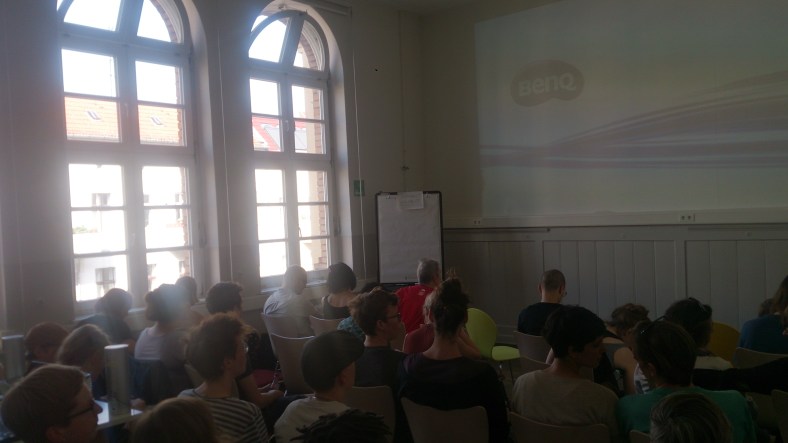
Sincere thanks for everyone who came out to our screening on Friday, May 24th at ISTA (Institut für den Situationsansatz) in Berlin-Kreuzberg. Also, to ISTA for making it happen.   We really appreciate it, but especially because Germany’s mainstream rarely asks the right questions, the hard questions. They especially don’t want to listen to the hard truths and honesty that can only improve them as human beings. Glad to share and that there were some good questions from the audience, with knowledge and introspection taken back to the communities.