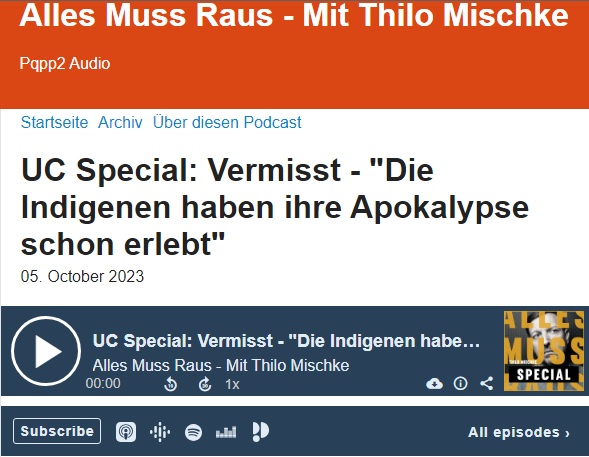
For those interested, here’s the link to my interview/the discussion on the “Alles Muss Raus” podcast with Thilo Mischke. Released on 5 October 2023, “The Indigenous have already experienced their Apocalypse”.
Looking back, I had no real issues with any of the questions. However, one of the first questions which I am paraphrasing, “Living in Germany now (or so long?) do these topics or things happening to Native Americans/First Nations affect you anymore?” was really surprising in a way, but in another, not so very because Indigenous peoples are generally perceived as sensitive/traumatized or distanced from. Maybe that is what they have perceived of us. I believe I paused before responding, because literally, just because you move someplace else or live someplace else you don’t stop caring for your family, your relatives, your peoples. We’re not animals adopted or moved away from a pet shelter who eventually have little or no memory of those times.
Another question that soon followed was also general, but not surprising, “Have you personally been affected by MMIW or related violence?” I did respond that I had been subjected to identity related violence and lost two uncles to discriminatory, racist violence at state/governmental hands or negligence. Women and girls have been targeted since DAY ONE of European invasion then 2S relatives, but men also, especially younger Indigenous men as was mentioned by Johnnie Jae (Otoe Missouri/Choctaw) in my documentary on the effects of stereotypes and racism, “Forget Winnetou! Loving in the Wrong Way” (2018).
Many Germans I’ve encountered through the years, whether referencing German society and family issues or others, often expressed their position that unless certain injurious things happened TO them or someone they personally knew in a close way, they had little or no interest in seeing justice done. ESPECIALLY if it were a topic they considered merely a difference of opinion like racial profiling and racial violence or transgender rights and protection. Considering the previous question and tone, if I had said I had not been personally affected in some way would it not then have been, “So, why should it matter to you? AKA Why are you speaking on these topics?” Actually, the questions should be, especially in a Germany who claims to love Native Americans and their cultures:
WHY SHOULDN’T IT MATTER TO EVERYONE?
WHY DO SO MANY IGNORE OR MINIMIZE THE SERIAL KILLINGS AND DISAPPEARANCES OF MMIW?
Finally, one discussion point I cannot help but mention whether included in the broadcast or not, I was speaking about positive collaborations between Germans/Europeans and the Indigenous that are rarely if ever mentioned in the media, who favor controversial, even adversarial treatment of anything Indigenous related. I mentioned how the alphabetizing of Ndee (Apache) languages was progressing since decades with the help of certain German linguists who’ve lived in proximity to Apache for decades.
As a similar example(?), the host mentioned that after Germans had recorded in print tattoo patterns that were unknown to Samoans today, before conducting massacres on the Samoan people. Thus those tattoos were only known now because Germans had preserved them, which a descendant or relative had wryly remarked upon with a laugh during an interview. To put it mildly, it is highly inappropriate for a German or other European to laugh also at this as if it were a “joke” joke. It was not. It was the still grieving, “wtf else can you do but laugh” so many Indigenous and other minoritized, marginalized peoples and groups know all too well. Granted, their laugh may have been ironical, but to be honest, that kind of gallows humor should only be used with someone you know very well, if then, as it can be seen as minimization of the trauma that still exists these communities due to invasion and genocide.
As the Samoan man and others remarked further in the documentary (and response to), OF COURSE, they would rather have had those relatives not be massacred and lose those tattoo patterns forever. And where is that book now anyway? I might lose, but I’d bet that book is NOT in Samoa, in the hands and/or total control of the Samoan people. Like so many precious cultural items of Indigenous peoples, they were looted, coerced and/or gained through violence, and have never been respectfully apologized for and corrected. Germany, like most European countries of the west, continue to hold hostage or apathetically fail to require their society to return such materials to their original peoples.
Those are my two outstanding observations on the interview, and any other issues if present, you can doubtless ascertain for yourself. 99.9% of the time, podcasts included, they provide you with a list of questions so you can prepare in some way. I was not. So, I feel I could have better answered some questions, though in hindsight one always remembers things they wish had included or said better. But yeah, here ya go.
 Forget Winnetou! Loving in the Wrong Way
You must be logged in to post a comment.