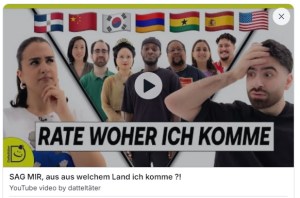
SAG MIR, aus welchem LAND ich komme!? – Participant in Datteltäter project (June 2024)

“I was contacted through NAAoG to be part of this episode in the series by Datteltäter on the cultural appropriation, racism, cultural ignorance and arrogance that still persists in Germany despite it being a long time multicultural country. Well, it’s no surprise really but it is somewhat different from other western European countries because many are uncomfortable with exploring or celebrating their our cultures and traditions, which are actually quite rich and varied but had been exploited pre-WWII. Instead some heavily beg, steal and borrow from other cultures, often using their privilege and wealth to further profit from the usage of other peoples.

It was filmed on 2 June in their studio on Gneisenauerstr. View the video here, my part starts at 10:40.
https://youtu.be/Y1vv7Eus_fI?feature=shared&t=640

Description: “Can you tell at first glance which country people come from? In this episode, the teams take on the challenge of matching people to their countries. From the American continents to the Far East, the teams compete for points and gain a fascinating insight into the countries of the world.”

“Erkennst du auf den ersten Blick, aus welchem Land Menschen kommen? In dieser Folge stellen sich die Teams der Herausforderung, Menschen zu ihren Ländern zuzuordnen. Von den amerikanischen Kontinenten bis in den fernen Osten kämpfen die Teams um die Punkte und bekommen einen faszinierenden Einblick in die Länder dieser Welt.”

25 Nov Premiere at Friedrichstadt-Palast #Berlin – Intercultural Cooperation & Positive Change

This slideshow requires JavaScript.

Instead of focusing on Thankstaking or that Germany as a whole only mentions Natives during times of controversy or misuse, tomorrow, 25 November at Friedrichstadt-Palast in Germany’s capital city, Berlin, we’ll see what’s up with the revamped scene featuring Native themes! It’ll be my first time seeing and hearing all components together after I served as cultural consultant on the scene set in the 1800s of the USA, for the youth show, “Spiel mit der Zeit”.

Around this time last year, I was contacted by one of the directors to provide feedback and cultural accuracy/representation on a scene, then it also evolved into co-writing song lyrics and feedback on costuming. They had heard about then viewed my documentary “Forget Winnetou! Loving in the Wrong Way”, and taken it into consideration in their internal discussions.

The main director was reviewing the show’s elements, having been a part of its original creation and so forth, but through educational efforts by so many Indigenous peoples and allies through the years, rightly decided it needed an update and overhaul to remove as many stereotypes and misrepresentations as possible. Then adding more culturally appropriate perspectives and insights on both sides of the camera, as it were: in consultation and creative action.

In Germany, if there’s a famous person wearing a “Native costume” to a party and there’s an outcry, if there’s a new film or book with Native slurs, stereotypes, perpetuating “white-washed” Eurocentric narratives of Native caricatures like 2022’s ridiculous but antagonistic debacle, or one of the USA’s holidays based on lies to erase their genocide and theft of Native lands and lives… then you might hear about Natives in the news. Or when Germans are complaining that educational efforts to stop Native stereotyping and misuse is taking away their freedom or German culture. (Which begs the question anyway, so racism is part of your culture?)

Every year there are dozens of articles and other media usually glamorizing “Indian hobbyists and hobbyism”, and the actors, directors, museum curators and so forth, who make their careers on Eurocentric possessiveness and “ownership” of Native cultures, traditions and history. Otherwise, ACTUAL Natives are usually ignored, especially if they are not the stereotype Germany prefers. Rarely IF EVER do you see stories of any kind about the positive collaborations, cooperations and endeavors Natives and non-Natives are accomplishing, which deserves note and celebration.

Friedrichstadt-Palast didn’t have to change anything about Native representation in their youth show, but they chose to do so. It’s 2023, and there’s firsthand information available at any time about other cultures, and actual cultural consultants from any culture where they can speak in person, especially in a huge city like Berlin. They didn’t remove the scene, although they considered it. They didn’t omit Native references, they didn’t rationalize their previous choices, nor get defensive when certain issues were pointed out. They had committed to positive change, and then worked in cooperation with myself and others to make it happen. Sure, more change still needs to be made and it understood that creatives who happen to be Native CAN ALSO be regular members of any production team anyway, this is a good step.

I will see the whole production tomorrow and post my review later, whether I had been a part of it or not, I applaud Friedrichstadt-Palast, its directors and others who I feel are a good example of what Natives have been asking all along: intercutural cooperation and changes in alignment with overall Indigenous perspectives regarding self-representation. Nothing was denied German or other European peoples who have relied on stereotypes, misrepresentation and misuse of Native cultures and peoples, and in fact, a better, more well-rounded and enjoyable show may have been attained. And what is even more important to me, a FAR BETTER EXAMPLE was set for the 1000’s of young people and others who will see the show, on how we can work together without Eurocentric narratives, red-facing, stereotypes.

Anyway, check out the trailer and other info about the show at the link.  https://www.palast.berlin/show/spiel-mit-der-zeit/

POSTPONED- 23-24 March Seminar in #Berlin – “Becoming and Teaching Human Beings: Critical Indigenous Perspectives”

23-24 March 2020, Red Haircrow will give a 2-day seminar: “Becoming and Teaching Human Beings – Critical Indigenous Perspectives for Daycare, School and Society at Institut für den Situationsansatz (ISTA) in Berlin. Written material will be available in German, with discourse in English and some German.

Registration is still open, but once class limit may be reached, interested persons can add their name to a waiting list. The program is designed for anyone interested in Indigenous perspectives, not just for educators or teachers. You can download the calendar and flyer from their website to share. German description below.

Description

“The tendency to ignore the needs of certain groups to represent themselves is a big problem in western society and continues to adversely affect all our children. How can we change this by incorporating accurate Indigenous knowledge and values into our classrooms and societies?   


We provide a brief overview of accurate Native American history, contemporary issues and experiences in German schools as a guide in writing curriculum and planning activities. We outline what inclusion, not appropriation, looks like by presenting culturally appropriate examples and resources.

We provide research on the effects of stereotypes and bias towards Native and other peoples. We answer the question, “What is really learned by children when other cultures and peoples are misrepresented and misused?”

We provide a contrast/comparison model of Indigenous worldview and values vs. Western Society/European values. We discuss the effects of these values on things like gender identity and expression, food and living choices, belief systems and the world around us.

We discuss how humanistic, empathetic values were lost, and how this has affected our educational systems and models. Our focus is to (re)discover these values in ourselves and find the best ways to return these values to our classrooms and societies.

We discuss how to incorporate appropriate Indigenous knowledge and “awakened” practices in classrooms and raise awareness on why culturally sensitive curricula and activities are necessary. We will amplify and share Native voices from around the world to encourage critical thinking and decision making by listening to others, not reading rulebooks. We want to make a support system on a journey to create a better world for all children.”


Deutsch

“Die Tendenz, die Bedürfnisse bestimmter Gruppen zu ignorieren, um sich selbst zu vertreten, ist ein großes Problem in der westlichen Gesellschaft und wirkt sich weiterhin nachteilig auf alle unsere Kinder aus. Wie können wir dies ändern, indem wir genaues indigenes Wissen und Werte in unsere Klassenräume und Gesellschaften integrieren?

Wir bieten Ihnen einen kurzen Überblick über die genaue Geschichte der amerikanischen Ureinwohner, aktuelle Themen und Erfahrungen in deutschen Schulen als Leitfaden in Aktivitäten Lehrplan und Planung zu schreiben. Wir zeigen, wie die Aufnahme, anstatt Aneignung, aussieht. Wir werden kulturell angemessen Beispiele und Ressourcen geben.

Wir bieten Forschung über die Auswirkungen von Stereotypen und Ausrichtung auf Einheimische und anderen Völkern. Wir beantworten wichtige Fragen wie: „Was  wird wirklich gelernt, wenn andere Kulturen und Völker falsch dargestellt und missbraucht werden?“ und „Wie falsche Darstellung der indigenen Völker andere Diskriminierung in der Gesellschaft verbinden?“

Wir bieten einen Kontrast / Vergleichsmodell der indigenen Weltanschauung und Werte vs. der westlichen Gesellschaft / Europäische Werte. Wir besprechen die Auswirkungen dieser Werte auf die Geschlechtsidentität und Ausdruck, Lebensmittel und Lebenswahl, Glaubenssysteme unserer Umwelt.

Wir erörtern, wie humanistische einfühlsame Werte verloren wurden, und wie dies unseres Bildungssystem und Gesellschaft betroffen hat. Unser Fokus ist diese Werte in uns selbst (wieder) zu entdecken, und die besten Möglichkeiten zu finden, diese Werte in unseren Klassenzimmern und Gesellschaften zurückzukehren.

Wir besprechen, wie  man angemessenes indigenes Wissen und „awakened“ Praktiken in den Klassenzimmern übernimmt, und das Bewusstsein darüber, warum kultursensible Lehrpläne und Aktivitäten notwendig sind. Wir teilen Native Stimmen aus der ganzen Welt um kritisches Denken und Entscheidungsfindung zu fördern, indem sie anderen zuhören anstatt Regelbücher  zu lesen. Wir wollen ein Support-Systeme kreieren um eine bessere Welt für alle Kinder zu schaffen.”

4 Dec -#Films Screening Event and Q&A “UNSEEN UNHEARD // The #Indigenous Perspective” in #Berlin

2019 has been extremely challenging, succinctly put. Endeavoring to finish up my next documentary by the end of this year, a shorter work titled, “ALMOST” on reality, identity and Indigeneity,  and the effects of stigma and prejudice. But before that, I have a couple of more screenings scheduled.

On this Thursday, 21 November, in cooperation with Xart Splitta, there’ll be a screening of “Forget Winnetou! Loving in the Wrong Way”, followed by a discussion with Filipina-German PhD candidate, activist and academic, Karin Louise Hermes.

On 4 December, I’m looking forward to the event being organized by Lada Suomenrinne, a Northen Samí filmmaker and photographer.

Image from Lada

UNSEEN UNHEARD // Indigenous Film Screening.  Program:

Unseen unheard is a selection of films about the indigenous perspective and experience curated by the young Sámi filmmaker and photographer Lada Suomenrinne.

The films by indigenous filmmakers from Norway, Finland and the USA deal with contemporary issues of the First Nations like the fight for land rights and against industrial destruction, decolonization and cultural appropriation. The screening will start at 19H in ACUD STUDIO and will followed by Q&A with Berlin based filmmaker Red Haircrow.

List of filmmakers:

Sunna Nousuniemi- Dissociate (Sámi)
Sky Hopinka- Dislocation Blues (Ho-Chunk/Pechanga)
Elle Márjá Eira & Mai-Lis Eira – The Sámi has rights (Sámi)
Blackhorse Lowe- Shimasani (Navajo)
Red Haircrow- Forget Winnetou! Loving in the wrong way (Chiricahua Apache/Cherokee)

FACEBOOK EVENT PAGE

VENUE PAGE 

21 Nov. #Documentary #Screening & Discussion in #Berlin with Xart Splitta & Guest – Karin Louise Hermes

  • Where –  Xart Splitta, Hasanheide 73, 10967 Berlin
  • Time – 7pm-10pm
  • Language– German & English (film & discussion)
  • Cost – Donations accepted
  • Facebook Event page

November is Native American Heritage Month, a national holiday in the USA. But there and here in Germany, the dehumanization and objectification of Indigenous peoples, and the minimization or erasure of historical acts and issues continues. Colonial behaviors and practices that are connected to the most serious, even life threatening problems humanity now faces.

Germany is well known for its cultural appropriation and ideation of American Indians. Misinformation, stereotypes and Eurocentric narratives are widespread. “Playing Indian” as a costume or a lifestyle has been normalized for generations, largely with the help or excuse of Karl May’s work.

Whether one agrees with such practices or not, most don’t recognize it for what it is: #Colonialism2019 and Systemic Racism. Why are Native and Indigenous issues too often left out of conversations on racism in Germany? Why do so many people, even anti-racism or social justice activists continue to tokenize/primitize Indigenous peoples and/or leave them out of conversations on how to survive and create a better world for all peoples?

What truly is intersectional activism and why is it critically important for Indigenous peoples, the history of their treatment and contemporary reality to take stage alongside any and every other action on anti-colonialism, anti-racism and climate crisis? What can you do? What should you do? How can we work together?

We’re going to talk about it on 21 November!


Meet our guest:

Karin Louise Hermes is a Filipina-German academic based in Berlin, Germany. Karin has participated in, organized and reported on many inter-sectional political issues at climate crisis conferences, during direct actions and demonstrations and other endeavors on Indigenous self-representation, ending racism and colonialism. She holds a MA in Pacific Island Studies from the University of Hawai’i, and is a PhD candidate in American Studies at Humboldt-Universität Berlin. One of her articles, “Why I protest“.

#Documentary Screening and Q&A -Why are Native/Indigenous issues too often left out of #racism discussions in #Germany?

Artwork by Natasha John

In cooperation with xart splitta, a screening and discussion at their location in Berlin. Facebook event page.

  • Where: Hasenheide 73, 10967 Berlin, Germany
  • When: 21 November 2019
  • Time: 7pm-10pm

November is Native American Heritage Month, a national holiday in the USA. But there and here in Germany, the dehumanization and objectification of Indigenous peoples, and the minimization or erasure of historical acts and issues continues. Colonial behaviors and practices that are connected to the most serious, even life threatening problems humanity now faces.

Germany is well known for its cultural appropriation and ideation of American Indians. Misinformation, stereotypes and Eurocentric narratives are widespread. “Playing Indian” as a costume or a lifestyle has been normalized for generations, largely with the help or excuse of Karl May’s work.

Whether one agrees with such practices or not, most don’t recognize it for what it is: #Colonialism2019 and Systemic Racism. Why are Native and Indigenous issues too often left out of conversations on racism in Germany? Why do so many people, even anti-racism or social justice activists continue to tokenize/primitize Indigenous peoples and/or leave them out of conversations on how to survive and create a better world for all peoples?

What truly is inter-sectional activism and why is it critically important for Indigenous peoples, the history of their treatment and contemporary reality to take stage alongside any and every other action on anti-colonialism, anti-racism and climate crisis? What can you do? What should you do? How can we work together?

We’re going to talk about it. Guests: TBA.


More about xart splitta: “xart splitta was founded in 2012 and is a non-profit association working in the field of intersectionality, antidiscrimination and (historical) political education. We work interdisciplinary and our formats and offers range from workshops and consultations, art & cultural productions to public discussions, conferences and symposia.”

RESCHEDULED to 14-15.09.2020 – Seminar in #Berlin- “Becoming and Teaching Human Beings – Critical #Indigenous Perspectives for Daycare, School & Society”

(RESCHEDULED TO 14-15 September, 2020).

23-24 March 2020, Red Haircrow will give a 2-day seminar: “Becoming and Teaching Human Beings – Critical Indigenous Perspectives for Daycare, School and Society at Institut für den Situationsansatz (ISTA) in Berlin.

Registration is open and can express your interest through their online form. The program is designed for every person, not just educators or teachers. You can download the calendar and flyer from their website to share. German description below.

Description

“The tendency to ignore the needs of certain groups to represent themselves is a big problem in western society and continues to adversely affect all our children. How can we change this by incorporating accurate Indigenous knowledge and values into our classrooms and societies? 


We provide a brief overview of accurate Native American history, contemporary issues and experiences in German schools as a guide in writing curriculum and planning activities. We outline what inclusion, not appropriation, looks like by presenting culturally appropriate examples and resources.

We provide research on the effects of stereotypes and bias towards Native and other peoples. We answer the question, “What is really learned by children when other cultures and peoples are misrepresented and misused?”

We provide a contrast/comparison model of Indigenous worldview and values vs. Western Society/European values. We discuss the effects of these values on things like gender identity and expression, food and living choices, belief systems and the world around us.

We discuss how humanistic, empathetic values were lost, and how this has affected our educational systems and models. Our focus is to (re)discover these values in ourselves and find the best ways to return these values to our classrooms and societies.

We discuss how to incorporate appropriate Indigenous knowledge and “awakened” practices in classrooms and raise awareness on why culturally sensitive curricula and activities are necessary. We will amplify and share Native voices from around the world to encourage critical thinking and decision making by listening to others, not reading rulebooks. We want to make a support system on a journey to create a better world for all children.”


Deutsch

“Die Tendenz, die Bedürfnisse bestimmter Gruppen zu ignorieren, um sich selbst zu vertreten, ist ein großes Problem in der westlichen Gesellschaft und wirkt sich weiterhin nachteilig auf alle unsere Kinder aus. Wie können wir dies ändern, indem wir genaues indigenes Wissen und Werte in unsere Klassenräume und Gesellschaften integrieren?

Wir bieten Ihnen einen kurzen Überblick über die genaue Geschichte der amerikanischen Ureinwohner, aktuelle Themen und Erfahrungen in deutschen Schulen als Leitfaden in Aktivitäten Lehrplan und Planung zu schreiben. Wir zeigen, wie die Aufnahme, anstatt Aneignung, aussieht. Wir werden kulturell angemessen Beispiele und Ressourcen geben.

Wir bieten Forschung über die Auswirkungen von Stereotypen und Ausrichtung auf Einheimische und anderen Völkern. Wir beantworten wichtige Fragen wie: „Was  wird wirklich gelernt, wenn andere Kulturen und Völker falsch dargestellt und missbraucht werden?“ und „Wie falsche Darstellung der indigenen Völker andere Diskriminierung in der Gesellschaft verbinden?“

Wir bieten einen Kontrast / Vergleichsmodell der indigenen Weltanschauung und Werte vs. der westlichen Gesellschaft / Europäische Werte. Wir besprechen die Auswirkungen dieser Werte auf die Geschlechtsidentität und Ausdruck, Lebensmittel und Lebenswahl, Glaubenssysteme unserer Umwelt.

Wir erörtern, wie humanistische einfühlsame Werte verloren wurden, und wie dies unseres Bildungssystem und Gesellschaft betroffen hat. Unser Fokus ist diese Werte in uns selbst (wieder) zu entdecken, und die besten Möglichkeiten zu finden, diese Werte in unseren Klassenzimmern und Gesellschaften zurückzukehren.

Wir besprechen, wie  man angemessenes indigenes Wissen und „awakened“ Praktiken in den Klassenzimmern übernimmt, und das Bewusstsein darüber, warum kultursensible Lehrpläne und Aktivitäten notwendig sind. Wir teilen Native Stimmen aus der ganzen Welt um kritisches Denken und Entscheidungsfindung zu fördern, indem sie anderen zuhören anstatt Regelbücher  zu lesen. Wir wollen ein Support-Systeme kreieren um eine bessere Welt für alle Kinder zu schaffen.”

2020 Workshop: “Becoming & Teaching Human Beings: Critical #Indigenous Perspectives for Daycare, School and Society”

Pre-registration information on a 2-day workshop being planned for March 2020, in cooperation with ISTA Institut für den Situationsansatz in Berlin. Details are being finalized now, and registration will be announced when open. German details below.

“Becoming and Teaching Human Beings: Critical Indigenous Perspectives for Daycare, School and Society”.

The tendency to ignore the needs of certain groups to represent themselves is a big problem in western society and continues to adversely affect all our children. How can we change this by incorporating accurate Indigenous knowledge and values into our classrooms and societies?

We provide a brief overview of accurate Native American history, contemporary issues and experiences in German schools as a guide in writing curriculum and planning activities. We outline what inclusion, not appropriation, looks like by presenting culturally appropriate examples and resources.

We provide research on the effects of stereotypes and bias towards Native and other peoples. We answer the question, “What is really learned by children when other cultures and peoples are misrepresented and misused?

We provide a contrast/comparison model of Indigenous worldview and values vs. Western Society/European values. We discuss the effects of these values on things like gender identity and expression, food and living choices, belief systems and the world around us.

We discuss how humanistic, empathetic values were lost, and how this has affected our educational systems and models. Our focus is to (re)discover these values in ourselves and find the best ways to return these values to our classrooms and societies.

We discuss how to incorporate appropriate Indigenous knowledge and “awakened” practices in classrooms and raise awareness on why culturally sensitive curricula and activities are necessary. We will amplify and share Native voices from around the world to encourage critical thinking and decision making by listening to others, not reading rulebooks. We want to make a support system on a journey to create a better world for all children.

Deutsch

Die Tendenz, die Bedürfnisse bestimmter Gruppen zu ignorieren, um sich selbst zu vertreten, ist ein großes Problem in der westlichen Gesellschaft und wirkt sich weiterhin nachteilig auf alle unsere Kinder aus. Wie können wir dies ändern, indem wir genaues indigenes Wissen und Werte in unsere Klassenräume und Gesellschaften integrieren?

Wir bieten Ihnen einen kurzen Überblick über die genaue Geschichte der amerikanischen Ureinwohner, aktuelle Themen und Erfahrungen in deutschen Schulen als Leitfaden in Aktivitäten Lehrplan und Planung zu schreiben. Wir zeigen, wie die Aufnahme, anstatt Aneignung, aussieht. Wir werden kulturell angemessen Beispiele und Ressourcen geben.

Wir bieten Forschung über die Auswirkungen von Stereotypen und Ausrichtung auf Einheimische und anderen Völkern. Wir beantworten wichtige Fragen wie: „Was wird wirklich gelernt, wenn andere Kulturen und Völker falsch dargestellt und missbraucht werden?“ und „Wie falsche Darstellung der indigenen Völker andere Diskriminierung in der Gesellschaft verbinden?“

Wir bieten einen Kontrast / Vergleichsmodell der indigenen Weltanschauung und Werte vs. der westlichen Gesellschaft / Europäische Werte. Wir besprechen die Auswirkungen dieser Werte auf die Geschlechtsidentität und Ausdruck, Lebensmittel und Lebenswahl, Glaubenssysteme unserer Umwelt.

Wir erörtern, wie humanistische einfühlsame Werte verloren wurden, und wie dies unseres Bildungssystem und Gesellschaft betroffen hat. Unser Fokus ist diese Werte in uns selbst (wieder) zu entdecken, und die besten Möglichkeiten zu finden, diese Werte in unseren Klassenzimmern und Gesellschaften zurückzukehren.

Wir besprechen, wie man angemessenes indigenes Wissen und „awakened“ Praktiken in den Klassenzimmern übernimmt, und das Bewusstsein darüber, warum kultursensible Lehrpläne und Aktivitäten notwendig sind. Wir teilen Native Stimmen aus der ganzen Welt um kritisches Denken und Entscheidungsfindung zu fördern, indem sie anderen zuhören anstatt Regelbücher zu lesen. Wir wollen ein Support-Systeme kreieren um eine bessere Welt für alle Kinder zu schaffen.
“Can you #copyright #culture?” Article &Video at dBs Studios #Berlin

From the event March 13, in the on-going series of discussions, dBs Dialogues in Berlin, at the dBs Film & Music School.

Last Wednesday, we came together for the second panel discussion of our diversity-themed season of dBs Dialogues: Can You Copyright Culture? On the panel was award-winning writer, educator, filmmaker and psychologist of Native (Chiricahua Apache/Cherokee) and African-American heritage Red Haircrow, whose multimedia work often focuses on identity, indigeneity and intersectionality. He was joined by Dutch producer and veteran of Berlin’s techno scene Charlton Ravenberg and Polish rapper and Creative Music Production & Sound Engineering student Augustyn. The fascinating talk was facilitated by Screen Acting vocal coach, cultural advocate and intercultural negotiation specialist Cavana Hazelton.”

Our #Indigenous film series began Nov. 7th in #Berlin – Next Date the 20th!

We had a nice turn-out for the 1st evening in our #Indigenous film series focusing on female directors, in cooperation with Xart Splitta, which began Nov. 7th in #Berlin.

The next event is Nov.20th, where my short docu, ALMOST, on mixed indigenous experience is followed by the feature length film, “Out of State” by Ciara Lacey on indigenous #Hawaiian prisoners will be viewed by guests at xart splitta.

The guest speaker that evening is Manuel Ricardo Garcia, (Jicarilla Apache, Coahuiltecan & German) born in Munich with Family in Chihuahua Mexico. Manuel is a Trans*activist, Photoartist, two spirit & active in the #LGBTIQA Black & #POC community.

Please view our full schedule here.